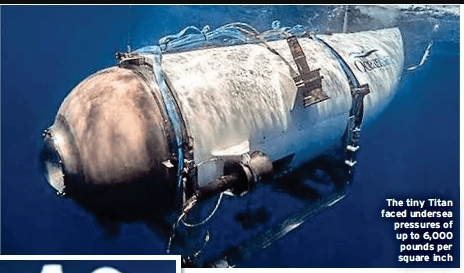
The five people gruesomely crushed into the size of a can of corn by the implosion of the Titan submersible during a tour ride to the Titanic wreck two-and-a-half miles below the sea’s surface didn’t have to die! That’s the shocking conclusion by experts who’ve called the tiny vessel an accident waiting to happen and questioned the durability of the Titan’s hull, which faced horrific pressures of up to 6,000 pounds per square inch during dives to the ocean liner’s watery grave.
Some scientists branded the mini-sub defective from the get-go. Many of the vessel’s trips had to be canceled or cut short due to mechanical problems, and even the Titan’s creator, who died in the June 18 doomed dive, confessed he’d broken safety and science rules to build his dream sub. Yet, despite the criticism and problems, the OceanGate deep-sea exploration company plowed ahead with the dives.
Before the tragedy, Stockton Rush, the 61-year-old cofounder of OceanGate and creator of the sub, said he’d “Like to be remembered as an innovator.” Two years ago, the former commercial pilot with a degree in aerospace engineering bragged about disregarding experts’ warnings, saying they think General Douglas MacArthur said, “You’re remembered for the rules you break.’ And I’ve broken some rules to make this.”
Incredibly, he even admitted the Titan’s construction materials flew in the face of what experts thought was safe.“The carbon fiber and titanium? There’s a rule you don’t do that,” he said, adding, “Well, I did!”
His crazed bravado led to his death and those of Paul-Henri Nargeolet, 77, a French deep sea explorer and Titanic nic expert; Hamish Harding, 58, a British billionaire businessman; Shahzada Dawood, 48, a Pakistani-British billionaire businessman; and Dawood’s 19-year-old ld son, Suleman, critics claim.
Incredibly, OceanGate charged passengers $250,000 a pop for this rich man’s thrill ride to the bottom of the North Atlantic and a view of the famed wreck of the passenger ship that sunk after hitting an iceberg on April 15, 1912, killing 1,500 passengers and crew.
Critics — including Titanic movie director James Cameron, a submersible buff and pioneer who’s made many deep dives — slammed Rush’s insistence on building the hull with a carbon fiber–titanium composite that engineers suggest weakens over time — leading to a “catastrophic implosion.”Once the hull failed, the passengers were instantaneously crushed by a monstrous force of 4,000 tons — or a weight of EIGHT MILLION POUNDS — suddenly toppling on top of them!
“You don’t use composites for vessels that are seeing external pressure,” Cameron says. “They’re great for internal pressure vessels like scuba tanks but terrible for external pressure. It’s not what they’re designed for.” He blames Stockton for using aviation engineering methods that are NOT for submersibles.
“We all said that it was, you know, a flawed idea, and they didn’t go through certification,” says the moviemaker.Cameron also insists the carbon fiber slowly damages and weakens “over time” until the implosion collapses.
“Each dive adds more and more microscopic damage. So, yes, they operated the sub safely at Titanic last year and the year before, but it was only a matter of time before it caught up with them,” the Hollywood mogul claims. Virginia Tech ocean engineering professor Stefano Brizzolara notes the composite hull material is “prone to possible defects” and “more fragile,” which could trigger “structural collapse.”
Incredibly, writer Arnie Weissmann, editor of Travel Weekly, says Rush previously admitted that the carbon fiber used in Titan’s construction wasn’t new but came from Boeing plane parts that had outlived their shelf life.
Meanwhile, another er source reveals that most of OceanGate’s 12,000-foot dives never made it to the Titanic’s wreck and had to be aborted due to various problems.
On a terrifying 2021 trip, businessman Bill Price says the vessel’s propulsion system died as they dove. Rush immediately wanted to surface but couldn’t because the “drop-weight mechanism” to release ballast wouldn’t work. Finally, the weights fell off after everyone inside rocked the vessel by moving from side to side.
“After several rolls, we heard a clunk, and we all collectively knew one [weight] had dropped off. So we continued to do that until the weights were all out,” Bill Price recalls.
Incredibly, the Titan made another dive the next day. But its final voyage to the bottom of the sea ended in death and disaster.









Leave a Reply